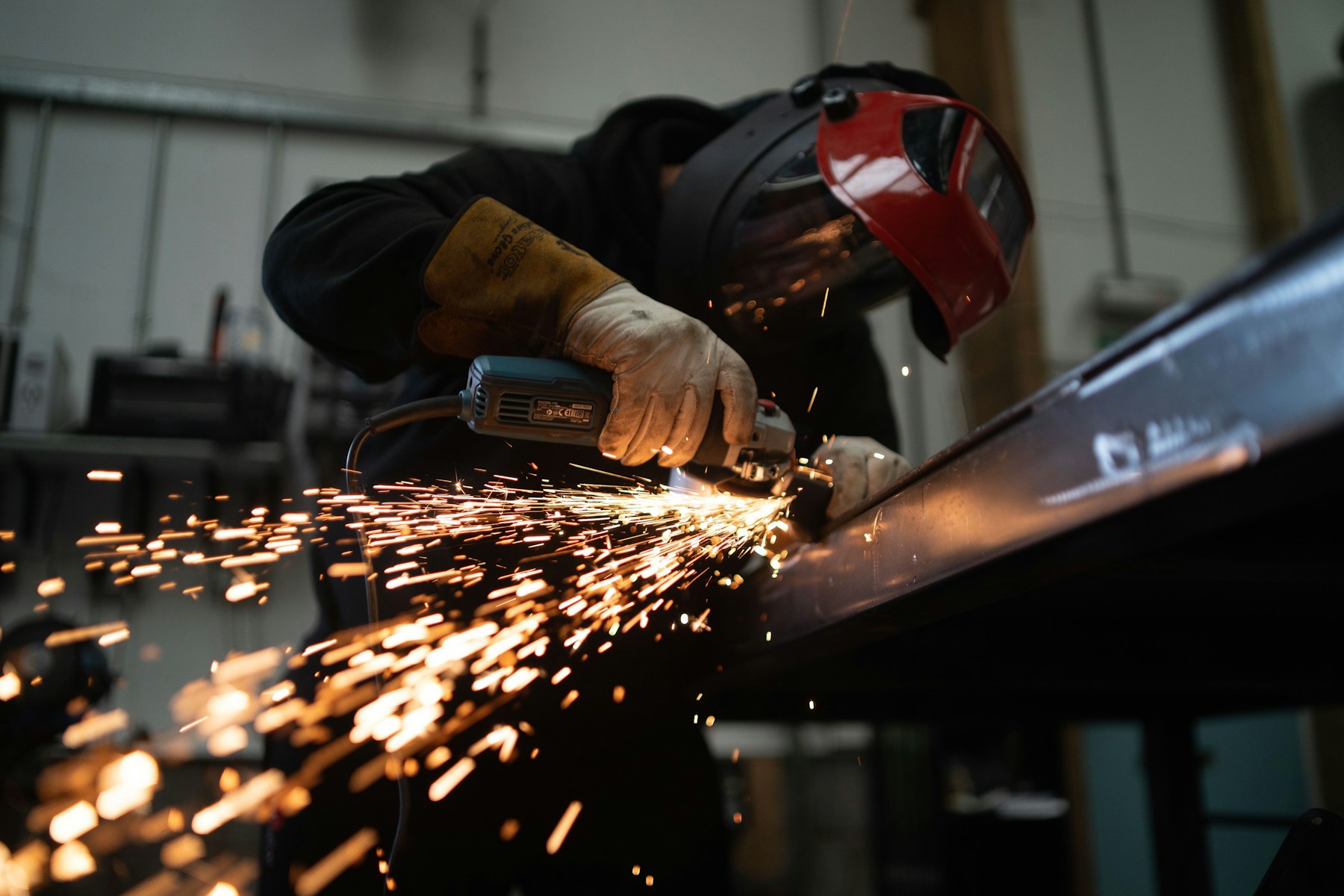
Hot work is the collective name for work that gives off heat or sparks somewhere that was not built for it. The decisive word is temporary. In a welding shop with ventilation, surfaces and extinguishing equipment designed for the purpose, the work is not hot work in this sense. The same weld carried out on the production floor, on the roof or inside a tank is.
Work that counts
- Welding and cutting with flame, arc or plasma.
- Cutting and grinding with machines that throw sparks.
- Soldering and work with an open flame, for instance roofing and membrane work.
- Drying, heating and hot-air work, where the heat rather than the spark is the risk.
- Work that generates heat through friction — drilling into dense material, chipping, machining that runs hot.
The risk sits after the work, not during it
During the work itself somebody is standing beside it with extinguishing equipment and their eyes on the job. The fire usually starts in a smouldering material nobody saw, in a space behind the wall that was welded, and takes hold hours later. That is why the after-watch exists, and why it must not be shortened so the crew can catch the ferry.
The order hot work is carried out in
- 1
Can the job be done cold?
The first question in the safety rules is whether the hot work needs to be hot at all. If the part can be cut mechanically, prefabricated in the shop or bolted rather than welded, the whole risk picture disappears and the remaining steps with it.
- 2
Assess the risk on site
The permit issuer walks the place: what is combustible, what is behind the wall, where the sparks go, and where the smoke goes if it does catch.
- 3
Write the permit
In writing, with the precautions the risk assessment arrived at. The permit is the work order for safety, and it covers that job, that place and that period of time.
- 4
Carry out the precautions
Combustible material is moved or covered, openings are sealed, extinguishing equipment is set out and the alarm route is checked. Only then may the work start.
- 5
Do the work with a fire watch
The fire watch keeps watch throughout and intervenes at the first sign of trouble. That role cannot be holding the torch at the same time.
- 6
Keep the after-watch
Watching continues for the time the permit states after the work has finished, and the place is checked one last time before it is left.
The certificate is an insurance term, not a law
This is the most common misunderstanding, and it matters. The requirement for a certificate does not come from work environment legislation but from the terms of the company's property and liability insurance. The consequence of not having one is therefore not, in the first instance, an enforcement notice. It is that compensation is reduced or refused after a fire you were responsible for, and that it comes to light during the claim, when it can no longer be put right.
The roles one by one
Fire watch
What watching actually involves, why it continues afterwards, and why the role cannot be shared with the person doing the work.
Permit issuer
Who may be appointed, what the permit has to contain, and what signing it means.
Certificates and validity
Where the date is, what happens when it passes, and how somebody else checks yours.
Questions about hot work
- Does it apply in our own workshop too?
- No, if the workshop is a permanent workplace intended and equipped for hot work. Yes, the moment the work leaves it — for the production line, the loading bay, the roof, or a customer's premises. The line is drawn at the place, not at who does the work.
- We hire a contractor. Whose responsibility is the certificate?
- The contractor's employees need their own certificates, but the permit is issued by whoever controls the site — that is, you. Buying in the work does not transfer permit responsibility to the supplier, which is one of the most common misreadings on the client side.
- Does the permit have to be written?
- Yes. A verbal go-ahead does not document which precautions were decided on, and that documentation is exactly what is asked for if something happens. The form is also a checklist: whoever fills it in goes through the points in the right order.
- Is one extinguisher enough?
- Which extinguishing equipment has to be at hand is decided in the risk assessment and written into the permit. It depends on what will burn if anything does, not on what happens to be hanging nearest the door.
Certifying the whole crew?
Tell us which roles you need to cover and we will say how many places that is and what it costs.
Contact us